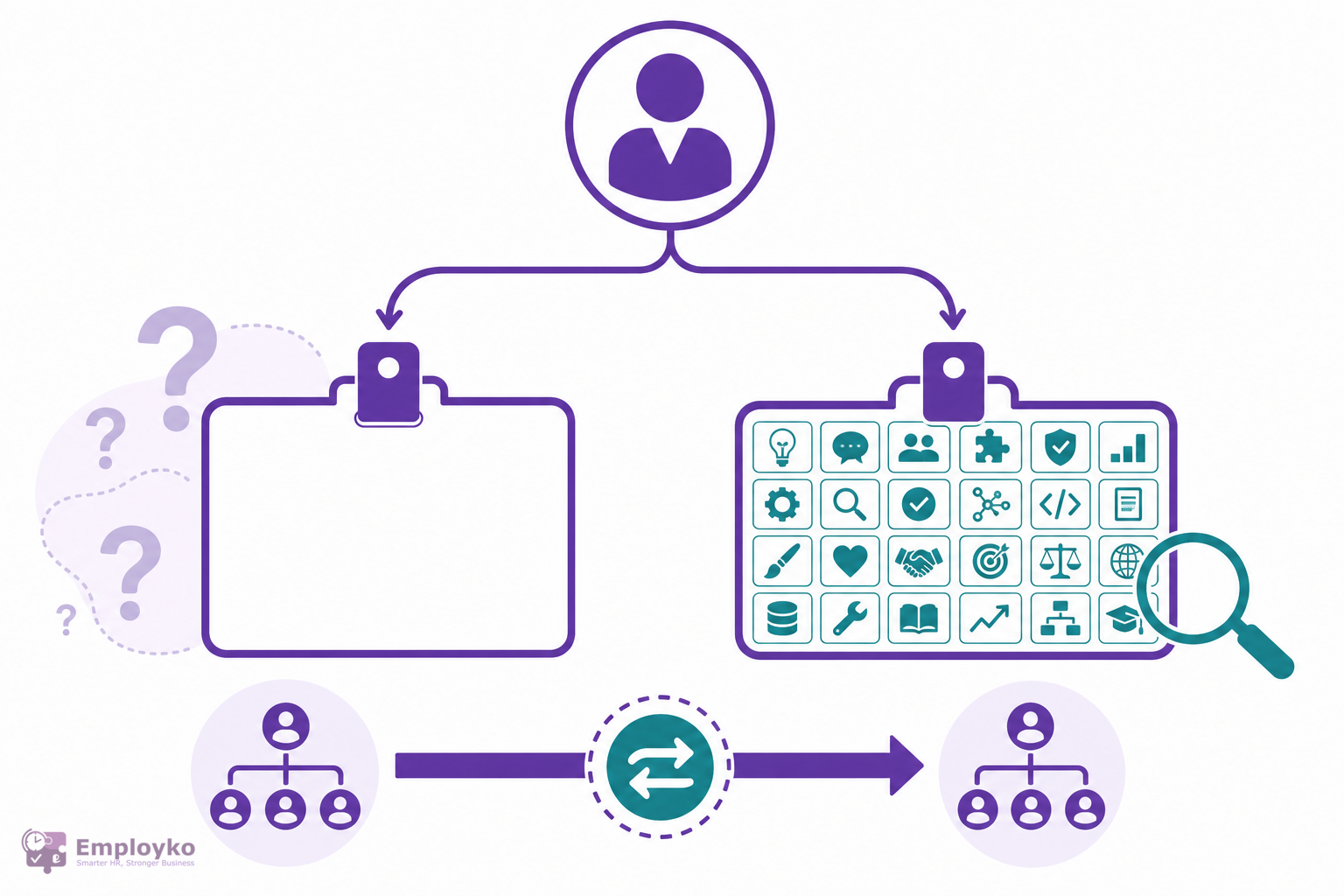
Skills-based hiring is the response to a fundamental recruitment problem: job titles that tell you almost nothing about actual capability. A "Senior Marketing Manager" might manage a team of 15 at one company, or just one person posting on social media at another. According to the 2026 State of People Strategy report, skills-based hiring is one of the top priorities for HR leaders this year.
What skills-based hiring actually means
Skills-based hiring means defining what a role requires in terms of demonstrable capabilities — not qualifications, not years of experience in a particular job title — and assessing candidates against those capabilities directly. The outcome is not necessarily a younger or less experienced workforce. It is a more accurately matched one.
Where it starts: the job description
Most job descriptions are a list of requirements that grew by accumulation over several hiring cycles — each hiring manager added what felt important to them, and nobody removed anything. A skills-based job description starts from the work that actually needs to be done and asks: what does someone need to be able to do to succeed in this role?
The internal mobility angle
Skills-based thinking is not only relevant to external hiring. It is arguably more valuable internally. When you have a clear skills map for every role in the organization, you can identify employees who have the skills for a different role before a vacancy even opens — enabling internal mobility that reduces external hiring costs and increases retention.
The practical challenge
The main barrier to implementing skills-based hiring is not willingness — it is the lack of a systematic framework. Without a consistent skills taxonomy and a way to capture and track skills across the organization, the process quickly becomes subjective and inconsistent. This is exactly the kind of structural challenge that an HR system should solve.