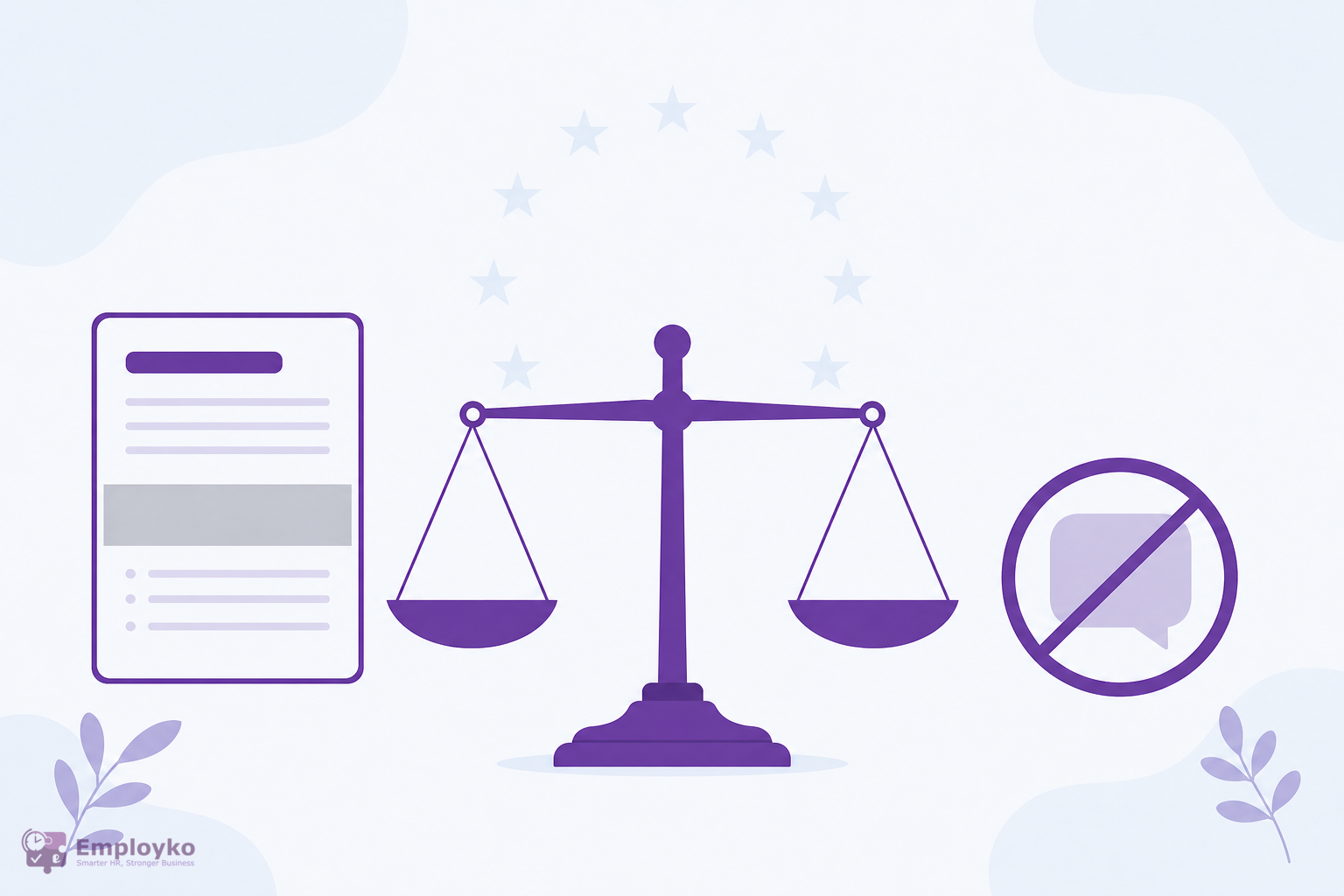
The EU Pay Transparency Directive (EU) 2023/970 requires equal pay between men and women for equal work. Member States had to transpose it into national law by June 7, 2026. If your company has not yet completed its preparation, the deadline passing does not remove the obligation — it makes the gap visible. Here is what the Directive requires and the five actions you should not leave unfinished.
What the Directive requires
1. Salary disclosure in job postings. Employers must disclose the starting salary or salary range for any advertised position, either in the job posting itself or before the interview. Asking a candidate about their current salary with a previous employer is prohibited.
2. Right to information for current employees. Every employee has the right to request information on the average pay levels, broken down by gender, for employees doing the same or comparable work.
3. Gender pay gap reporting. Companies with 250 or more employees must report their gender pay gap annually. Companies with 150-249 employees must report every three years.
4. Joint pay assessment. Where the pay gap between men and women exceeds 5% and cannot be explained by objective factors, the employer must conduct a joint assessment with employee representatives and implement corrective measures.
Five actions you should not skip
Use this as a practical checklist — especially if any item is still open on your side:
- Run an internal pay audit — analyse gender pay gaps for comparable positions and record your methodology
- Define which roles are of equal value — create or update your job classification system before disputes arise
- Publish salary ranges for open roles — every active vacancy should have a defensible range, not an ad-hoc figure
- Retrain recruitment — remove questions about current salary from interviews, forms, and agency briefs
- Document your pay logic — be able to explain differences with objective, auditable criteria
Source: Innovires Legal, Employment Law Bulgaria 2026; Directive (EU) 2023/970
Pay transparency is not a one-off compliance task. It changes how salaries are set, communicated, and defended every month. Teams that close these five gaps now reduce inspection and reputational risk — and avoid the expensive scramble that follows when preparation was postponed.