As of 2025, Bulgarian labor law introduces a simplified procedure for temporarily changing an employee's place of work for up to 30 working days per calendar year. Previously, any change to the agreed place of work required a formal written annex to the employment contract. The new provision allows a lighter-touch process — making remote work and hybrid arrangements significantly easier to manage administratively.
What the rule covers
The new provision applies to any temporary change of workplace — including working from home, from a co-working space, or from a different company location. The key conditions are that the change must be temporary (within the 30-day annual limit) and agreed between employer and employee.
What it does not change
The rule does not alter the employee's pay, working hours, or other contract terms. Health and safety obligations remain with the employer regardless of where the employee works. The employer must still ensure the employee has the equipment and connectivity required to do their job.
Practical implications for HR
For HR teams, this is primarily a documentation challenge. You need a system to track how many temporary remote days each employee has used, ensure the 30-day limit is not exceeded, and maintain a record of the arrangement. A chat message or a verbal agreement is not enough — you need a written record, even if it is a simple email or a request logged in your HR system.
Source: da-law.eu, Legislative Changes in Labour Law 2025; trudipravo.bg
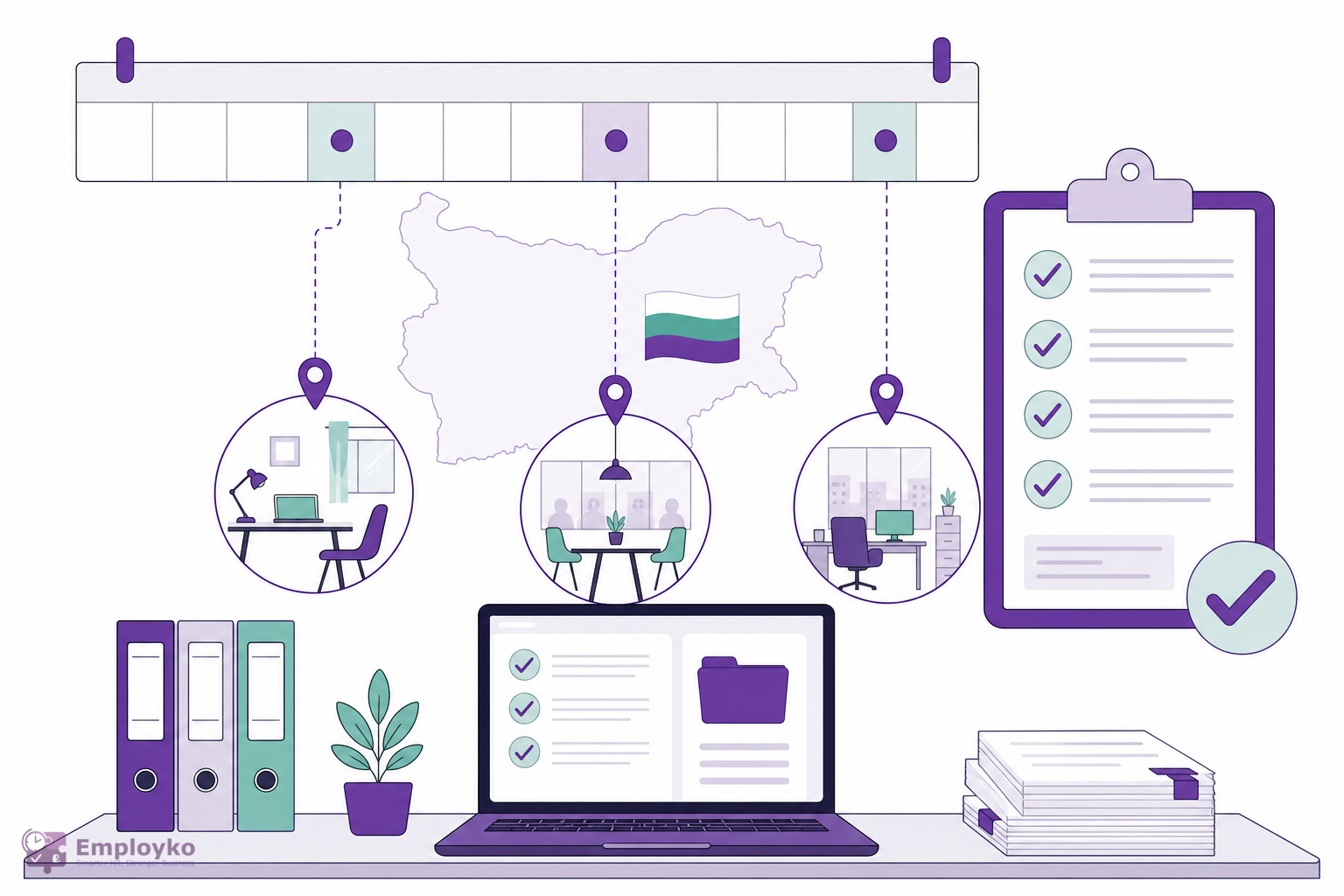
Employer checklist for temporary remote work
- Confirm the change qualifies as temporary (maximum 30 working days per calendar year per employee)
- Prepare a written annex to the employment contract specifying the remote work period, location, and working hours
- Notify the National Revenue Agency (NRA) via the employee's employment record before the change takes effect
- Ensure the remote work location meets health and safety requirements under the Ordinance on Home and Remote Work
- Document the employee's written consent
Failing to follow these steps — even for a short two-week remote arrangement — exposes the company to fines from the Labour Inspectorate of up to BGN 15,000 per violation.